Showing posts with label Institutional QA. Show all posts

Tuesday, 11 November 2025

Skills-First Ecosystem Framework

The skills-first economy is an emerging paradigm where economic growth and workforce strategies anchored on skills mastery over formal qualifications.  It has reshaped recruitment practices to hire on what individuals can do rather than what degrees they hold. This approach is expected to expand talent pools, improving equity, and aligning workforce development with fast-changing industry needs, technological advances and demographic shifts. Since 2019, there has been a growing trends towards skills-based hiring and several major companies like IBM, Google, Cisco, Walmart and Boeing have implemented a skills-first approach in their hiring and talent management strategies. 

The shift towards skills-first led to the establishment of a Skills-First Readiness and Adoption Index which is jointly developed by OECD and the Centre for Skills-First Practices (CSFP) at the Singapore University of Social Sciences-Institute for Adult Learning (SUSS-IAL). 

Source: https://www.oecd.org/en/data/dashboards/skills-first-readiness-and-adoption-index.html

The rise of a skills-first economy has profound implications for higher education, especially in curriculum design, credentialing, assessment and graduate employability. HEIs must shift from emphasizing knowledge to future-ready skills, co-create skills-based curriculum with stakeholders, integrating microcredentials, badges, skill certification and authentic performance or skills-based assessment as employers seek out graduates who demonstrate job-ready skills rather than academic knowledge. 

The Skills-First Ecosystem Framework is conceptualized to facilitate HEIs to implement skills-first ecosystem with the support from their national agencies.


Wednesday, 5 November 2025

OBE Ecosystem Approach to Future-Ready Education

The 9th AUN-EQI workshop on "OBE Ecosystem Approach to Future-Ready Education" was held on 28 - 31 October 2025 in Bangkok, Thailand. The workshop was a collaborative capacity building initiative between ASEAN Quality Network (AUN) and Education Quality International (eqi) and was attended by participants from universities in the Philippines.

The OBE Ecosystem Framework (Version 5) was developed to advance future-ready education and to prepare higher education instiutions to be future-ready in the world of disruptions. The following fundamental principles of OBE ecosystem framework were extensively discussed:

  • WISER outcomes: outcomes: learning outcomes that are formulated based on the work of the future, vertical and horizontally aligned, significance and SMART, ecosystem perspective and real-world learning.
  • Ecosystem curriculum design: The system to design future-ready curriculum requires both outside-in (ecosystem) and inside-out (microsystem) approaches with an emphasis on integrated curriculum best practices and designs.
  • Real-world learning: learning should involve real world challenges and real-world tasks in bridging the gap between theory and practice gap so as to develop graduates’ work readiness by focusing on nurturing attributes towards employability and lifelong learning.
  • Integrated constructive alignment: curriculum should embrace an integrated (vertical and horizontal) constructive alignment within and outside the programme and institution with the ecosystem.

Case studies were held to reinforce the underatnding and application of the OBE Ecosystem Framework.

Advancing Outcomes-Based Education (OBE) and Internationalization of Higher Education at the Ministry of Education and Sports (MoES) in Lao PDR

The workshop on Outcomes-Based Education (OBE) and Internationalization of Study Programmes was held on 22 - 23 October 2025 in Vientiane, Lao PDR for the Minsitry of Education and Sports (MoES) and supported by the LuxDev Lao/037. 

The workshop was graced by Dr.Ammany Norrlinl, Deputy Director General of Higher Education, Ministry of Education and Sports (MoES), Dr. Somdeth Keovongsak, Dean of Faculty of Law and Political Science, National University of Laos, and Mr. Thomas Lammar, Charge d Affaires of the Embassy of the Grand Duchy of Luxembourg. It was attended by more than 50 participants from the Ministry of Education and Sports, public and private universities and institutions in Lao PDR, and  facilitated by international curriculum experts of Education Quality international (eqi).

The 2-day workshop aims to advance outcomes-based education (OBE) and internationalization of study programmes at MoES and universities of Lao PDR in a holistic and unified way to raise the quality of higher education. The workshop was structured into 2 sessions with the first focused on OBE Framework and principles and the second on the internationalization of study programmes. The learning outcomes of the workshop were: 

  • Apply the OBE framework and its principles to advance OBE implementation;
  • Relate internationalization strategies and frameworks to advance internationalization of study programmes in higher education; and
  • Formulate indicators to measure the success of OBE and internationalization implementation.
The workshop was concluded with the experts outlining the way forward for the participants and their institutions. It was closed by Dr.Ammany Norrlinl, Deputy Director General of Higher Education, Ministry of Education and Sports (MoES) with a certification presentation ceremony to the participants by Dr. Reginald Pastrana, Senior Sectoral Advisor, Lux Development Programme LAO/037.

Thursday, 25 September 2025

OBE Ecosystem Approach to Future-Ready Education at Davao Doctors College, Davao City, the Philippines

The 4.5-day “OBE Ecosystem Approach to Future-Ready Education” workshop was designed for Davao Doctors College with a focus on course syllabus development. The workshop was hosted at Davao Doctors College, Davao City, the Philipines from 8 to 12 September 2025 and facilitated by Education Quality International (eqi).


The workshop aims to advance OBE in a holistic and unified institutional approach to enhance the design of the study programmes for future-ready education.

Saturday, 21 June 2025

OBE Ecosystem Approach to Future-Ready Education Hosted by the Faculty of Law and Political Science (FLP), National University of Laos (NUOL)

The OBE Ecosystem Approach to Future-Ready Education workshop was held on 4 to 5 June 2025 in Vang Vieng and was graced by Dr. Reginald Pastrana, SSA of LAO/037, Asst. Prof. Thongsouk Keomany, Vice President of NUoL and Dr. Somdeth KeovongSack, Acting Dean of FLP. More than 60 participants from NUoL, FLP, FLA (Faculty of Law and Administration, Champasak University), and representatives from the Ministry of Education and Sports, Lao PDR and the Lux037 project office attended the capacity building workshop. A curriculum review meeting was held on 3 June 2025 as a prelude to the OBE Ecosystem workshop. The curriculum review and the workshop were faciliated by two experts - Dr.Nguyen Thi My Ngoc and Johnson Ong Chee Bin.

The aims of the workshop were to advance OBE implementation in a holistic and unified way by identifying and mapping the ecosystem that affects the design of study programmes as well as to equip participants with the competencies to review and re-design curriculum based on the OBE Ecosystem Framework. The experts shared good practices of integrated curriculum implemented in universities within and outside ASEAN for the participants to consider. They also shared examples of undergraduate programmes offered by the National University of Singapore (NUS), Singapore Management University (SMU) and University of Economic and Law, Vietnam National University-Ho Chi Minh City. Besides, the use of AI as a tool in curriculum design and development was shared and discussed. 

The workshop was concluded with the experts outlining the way forward with key follow-up actions including establishing the ecosystem of FLP and relate it to each study programme, ccollecting the ecosystem intelligence including stakeholders’ needs and reflecting them into the curriculum, applying integrated curriculum, specialisations, tracks, minors, greater emphasis on teaching and learning and student assessment to assure of constructive alignment and real-world learning, and finally to monitor and report the objective and subjective measures of both programme and course learning outcomes of the programme.

Monday, 2 December 2024

Training on Education Quality Assurance and Accreditation for Vietnamese Higher Education Institutions

The conference on "Training on education quality assurance and accreditation for Vietnamese higher education institutions" was hosted online by Vietnam Education Quality Management Agency of the Ministry of Education and Training (MOET) on 26 November 2024.

Mr. Johnson Ong Chee Bin, Founder and Principal Consultant, Education Quality International was one of the two invited key speakers at the conference. He shared the experience of AUN-QA programme outcome assessment and the way forward for higher education in Vietnam.

The conference was attended by more than 300 higher education institutions and accreditation agencies in Vietnam.


Sunday, 1 December 2024

Right Measure, Measure Right

The fundamental principle of an effective measurement system is first to ensure the right measure and then to find ways to measure right, with the aim of seeking continuous improvement.

"Right measure" emphasizes the importance of validity in choosing the correct metric to assess what truly matters to stakeholders.

"Measure right" highlights the need for reliability in ensuring accuracy and consistency in how measurements are taken, reported and used for improvement. 

The metrics for each component of a system should be established with the consideration of institutional context, stakeholders needs and ecosystem.


Tuesday, 13 August 2024

Future-Ready Education (OBE Ecosystem)

Future-ready education or OBE Ecosystem is conceptualized based on the principles of future-ready outcomes-focused, ecosystem-focused and stakeholders-centred.

It is based on the management strategy of ecosystem approach and future sensing, stakeholders agency, collaboration and shared responsibility in designing ecosystem defined programmes. The theoretical basis are growth mindset, future skills and lifelong learning, measurable WISER outcomes, criterion referencing and integrated constructive alignment. WISER outcomes are outcomes that are formulated based on the Work of the future, Integrated constructive alignment, Significance and SMART, Ecosystem perspective and Real-world learning. It aids in designing curriculum content that is holistic, integrated and future-ready.
The process of education in future-ready education emphasizes student holistic development and wellbeing, and real-world learning. Curriculum planning in future-ready education is ecosystem, agile, holistic with integated constructive alignment and future-ready. It requires curriculum to be future-ready, integrated, real-world learning and flexible.
(c)Education Quality International (2024)


Friday, 26 July 2024

OBE Seminar at National Economics University (NEU), Hanoi, Vietnam

L.Y.D.I.N.C Ltd. Company (LYDINC), in collaboration with Education Quality International, successfully organized a hybrid seminar on "Sharing Practical Experience On Developing Expected Learning Outcomes and Curriculum that Meet National and International Quality Assurance and Accreditation Standards" at the National Economics University (NEU) on 12 July 2024.

Mr. Johnson Ong Chee Bin, Founder and Principal Consultant delivered virtually a topic on "Outcome-based Education: Modern Approach of OBE World-Wide and OBE in Economics, Management and Business" at the seminar. 


Ecosystem Approach to Outcomes-Based Education (OBE) at Ateneo de Manila University

The 3.5-day “Ecosystem Approach to Designing and Implementing OBE” workshop was designed to equip faculty members and academic staff from the higher education cluster at Ateneo de Manila University with the competencies to design, develop, implement and evaluate study programmes based on the OBE Ecosystem Framework from Education Quality Internetional. The workshop was orignally plan from 28 May to 31 May however due to unforeseen circumstances, the workshop on 31 May was rescheduled to 26 July 2024 (online).


Monday, 24 June 2024

14th PAFTE Midyear Convention 2024

The 14th PAFTE Midyear Convention 2024 was held online from 13 to 14 June 2024. Mr Johnson Ong was invited as a resource speaker and he shared the topic on "Promoting Global Education through ASEAN University Network-Quality Assurance.


Wednesday, 1 May 2024

PDCA of Outcomes-Based Education (OBE) at University of Economics and Law

A 1-day workshop on "The PDCA of Outcomes-Based Education (OBE) " was hosted by the Univesity of Ecomomics and Law, a member university of the Vietnam National University-Ho Chi Minh City on 19 April 2024. The workshop was facilitated by Mr. Johnson Ong Chee Bin and Dr. Nguyen Thi My Ngoc and was attended by about 30 participants. 


Friday, 1 March 2024

Best Practice in OBE Competition at Mapua University, the Philippines

Mr. Johnson Ong Chee Bin, Principal Consultant was invited as one of the two panel judges for the "Best Practice in OBE" category in the Paglilinang 2024 on 19 Ffebruary 2024. The evaluation was held virtually.


Wednesday, 7 February 2024

A Cafeteria Approach to Curriculum Design

The cafeteria approach to curriculum design is based on the principles of flexibility and empowerment that allow students to customise their curriculum based on their aspirations as well as in fulfilling the institutional ambitions, stakeholders' needs and contextual factors. It allows students to choose courses from baskets of different course categories. The courses in each course category are like the dishes in the menu of a cafeteria that can be changed very quickly to meet the changing tastes and preferences of the consumers (i.e. stakeholders).

The cafeteria approach to curriculum design is non-linear, agile and can respond to the changing needs of the ecosystem rapidly without compromising the quality of education. It closes the gaps between the employability of the graduates and the labour markets. It is an alternative to the traditional rigid, linear, unresponsive cyclic curriculum design process.


Monday, 29 January 2024

AUN-QA Community Project for Universities in Myanmar

The AUN-QA community project aims to provide universities in CLM countries with greater opportunities to harmonize their education within the ASEAN higher education area as well as to uplift their higher education systems, develop and sustain their quality assurance at programme and institutional levels based on AUN-QA framework.

As part of the larger aim, the AUN-QA Network has launched a 5 years (2023 to 2027) community project for universities in Myanmar involving the following 3 phases:

  • Phase 1a - Data and information gathering and selection of study programmes to undergo AUN-QA programme certification;
  • Phase 1b - Training representatives of the participating universities on the AUN-QA programme framework (version 4) and gaps analysis of the selected study programmes as well as the documentation of IQA Manual and IQA plan;
  • Phase 2 - Self-Assessment Report (SAR) preparation and writing; and
  • Phase 3 - Preparation of AUN-QA programme assessment.

The kickoff workshop (online) has begun on 17 January 2024 and lasted through 30 January 2024. During the 5-year period, relevant training workshops, coaching and hand-holding activities will be held to the participating universities for uplift their selected study programmes to meet the AUN-QA programme standards.


Thursday, 14 December 2023

The 15th Higher Education International Conference, Macao Polytechnic University and Asia-Pacific Quality Network

The 15th Higher Education International Conference - Artificial Intelligence and Pedagogical Transformation: Implications for Higher Education Quality Assurance jointly hosted Macao Polytechnic University and Asia-Pacific Quaity Network was held from 11 to 13 December 2023 at Macao Polytechnic University, Macao, China.

Mr. Johnson Ong Chee Bin, Founder and Principal Consultant of Educaction Quality International and AUN-QA Expert gave a keynote speech on "A Future-Ready Quality Assurance of Higher Education in the World of Artificial Intelligence and Disruptions" The presentation shared the disruptions arise from AI and the VUCA world and how institutions can ride above the waves of disruptions by embracing the ecosystem perspective, innovation, autonomy and agility to redesign a future-ready quality assurance of higher education.


Thursday, 4 May 2023

AUN Internal Quality Assurance (IQA) System Design and Development Workshop, Vietnam

Mr. Johnson Ong Chee Bin, Founder & Principal Consultant of Education Quality International and AUN-QA Expert was invited by the AUN-QA Network and MOET as the resource person at the AUN-QA IQA System Design Development Workshop hosted by the AUN-QA Network, MOET and VNU-HCM on 25 - 26 April 2023.

The workshop was attended by representatives from the members and associate members of the AUN-QA Network. Mr. Johnson delivered a trigger presentation - Towards a Future-Ready IQA System at the workshop.


Friday, 20 January 2023

The Rise of the Artificial Intelligence (AI)

Recently, news and articles have been circulating in newspapers, journals and social media about ChatGPT (https://openai.com/blog/chatgpt/), a AI system that generates its own original answers based on all the information it has gathered and learned. Students have been caught using ChatGPT to cheat (https://www.businessinsider.com/chatgpt-essays-college-cheating-professors-caught-students-ai-plagiarism-2023-1. Alarmed by AI's competence, some universities are overhauling their student assessments and some are thinking of banning it all together to uphold academic integrity (https://www.japantimes.co.jp/news/2023/01/18/world/ai-chatbots-alarm/). 

Indeed, ChatGPT has raised many uncomfortable questions about teaching and classroom learning as written by Asst. Professor Victor Lim Fei from the National Institute of Education, Nanyang Technology University which was published in The Straits Times (https://nie.edu.sg/about-us/news-events/news/news-detail/chatgpt-raises-uncomfortable-questions-about-teaching-and-classroom-learning). It is amazing that almost 30% of professionals have tried ChatGPT at work as reported by Fishbowl, a social platform owned by employer review site Glassdoor.  (https://www.straitstimes.com/world/united-states/almost-30-of-professionals-say-they-ve-tried-chatgpt-at-work?utm_campaign=stfb&utm_medium=social&utm_source=facebook).

As a quality assurance expert, consultant, facilitator, educator and assessor, I was curious and decided to test the ChatGPT. I asked three (3) pertinent questions relating to academic quality and quality assurance. My first question was "How to write a self-assessment report for programme accreditation" and the answer I got was a step-by-step process which was both logical and systematic.


My next question was "What need to be written in the self-assessment report for AUN-QA programme assessment" and the response was surprising given that ChatGPT is able to list the structure and nature of the self-assessment report for AUN-QA programme assessment. 


I became more curious and decided to ask a popular academic question which was often raised by my peers and quality assurance practitioners. My third and final question was "How to measure expected learning outcomes" and I was impressed with the answer from ChatGPT which gave a comprehensive list of methods in which few were not commonly mentioned.


Is ChatGPT a threat or an opportunity? Will AI replace teachers? How can educational institutions, content creators and training providers rise over the age of AI? 

AI definitely will be a threat to those who simply create learning contents which could easily be reproduced through AI systems like ChatGPT. AI at its current technology is unlikely to replace teachers in two aspects: compassion and passion. The technology has yet to reach a stage to replace the "heart" but not the "mind" of a teacher. 

To rise above the age of AI, educational institutions, content creators and training providers need to move beyond contents creation to designing learning experiences. Teachers, facilitators and trainers need to teach what is not there!

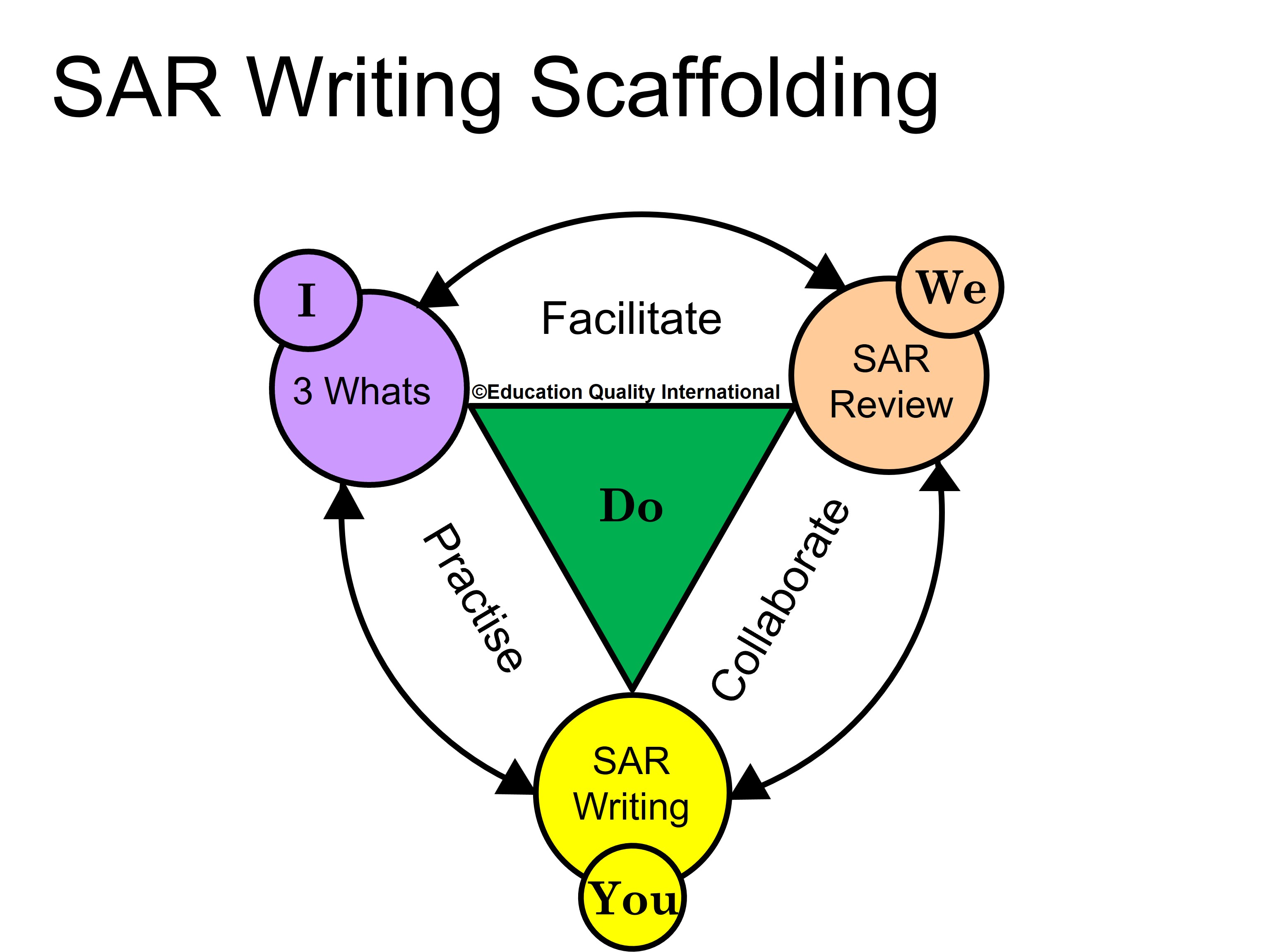
Let me share how eqi has transformed itself beyond creating learning content to designing learning experience that facilitates personalised learning for real-world application. The design of learning experience for "Self Assessment Report (SAR) Writing for Successful AUN-QA Programme Assessment" was an example. The first question that we asked our participants was not what they need to know or learn but what challenges and difficulties that they faced in preparing and writing SARs. Empathizing with our participants led us to better understand their needs and designing the training to fulfill them. The integration of ADDIE and design thinking approaches guided us to design personalised learning for real-world application.


A blended workshop with SAR writing scaffolding using "I Do, We Do, You Do" was conceptualised for the SAR writing workshop as illustrated in the diagram below.

This holistic integrated approach creates a unique learning experience for participants to learn what is not there and facilitates the development of key competences to write SARs that are uniquely theirs.


Sunday, 7 August 2022

The Ecosystem of Curriculum (Re)design in Higher Education Institutions

The presentation of "The Ecosystem of Curriculum (Re)design in Higher Education Institutions" was shared by Dr. Nguyen Thi My Ngoc and Mr. Johnson Ong Chee Bin at the  international conference "Innovative Leadership in Higher Education: Global Trends and Practices in the Post COVID-19 Pandemic" hosted online from 7 - 8 July 2022 by SEAMEO RETRAC, Vietnam.

The presentation shares the key challenges in the VUCA world, their impacts on higher education and how higher education institutions can ride above the wave of disruption by (re)design their curricula from a multidirectional or ecosystem perspective.  The conference was attended by more than 300 participants from ASEAN and the region.


Sunday, 26 June 2022

SHARE Peer Multiplier Training (PMT) 2022

The 4-day hybrid EU-SHARE Peer Multiplier Training (PMT) 2022 was hosted by DAAD from 20 - 23 June 2022 in Jakarta, Indonesia. The 32 participants were from Indonesia, Malaysia, Lao PDR, Myanmar, Philippines and Vietnam. The workshop was facilitated online and F2F by trainers from ASEAN and Europe. Mr. Johnson Ong Chee Bin facilitated the following sessions:

  • The Five-Stage Online Facilitation Model
  • Ice Breakers for Dissemination/Multiplication Projects  
  • Change Management
  • Evaluating the Success and Effectiveness of OBE Training and Implementation